LAUNCHING FUTURES: Eastern Florida State College’s Aerospace Technology Program Soars to New Heights
By Sascha Lee, Eastern Florida State College // May 31, 2025
program is gateway to high-demand, high-skill careers in one of world’s most exciting industries

CLICK HERE TO ENROLL TODAY!
BREVARD COUNTY, FLORIDA – Eastern Florida State College’s Aerospace Technology program is a gateway to high-demand, high-skill careers in one of the world’s most exciting industries.
Based in Florida’s Space Coast, a region teeming with aerospace giants like NASA, SpaceX, and Blue Origin, the program offers students the rare opportunity to gain hands-on experience working with the same technologies powering today’s space missions.
Through a curriculum grounded in real-world application, strong industry ties, and faculty with decades of NASA experience, EFSC is preparing the next generation of aerospace technicians, quality specialists, and engineers. And the results speak for themselves in the classroom and national stage.
Program Overview and Highlights
Led by Program Manager Ed Mango, a 34-year NASA veteran, EFSC’s Aerospace Technology program uniquely focuses on spacecraft and launch vehicles, not just aviation.
“We are the only program in Florida, and really in the U.S., that focuses on aerospace technology as it applies to being a technician or quality specialist for space systems,” Mango explained.
Students can choose between certificate pathways or an Associate of Science (AS) degree in Aerospace Technology. Mango strongly encourages the AS degree route for long-term career growth, especially for those interested in supervisory roles.
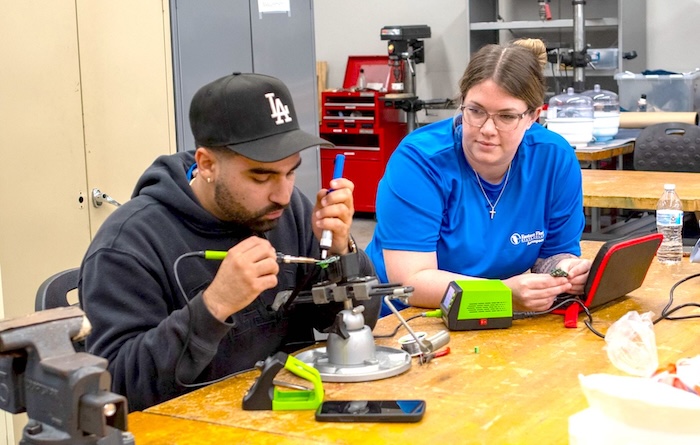
The cornerstone of the curriculum is hands-on training. Students work on everything from rocket propulsion systems using cryogenic fuels to soldering circuit boards, assembling aerospace structures, laying composites like carbon fiber, and troubleshooting real-world systems.

Mango’s background fuels the program’s authenticity. As launch director for the Ares I-X mission and manager of the Commercial Crew Program, he brings decades of insight into classroom instruction and program design.
And the results are measurable.
“Right now, 95% of our students are placed before graduation,” Mango said.
“Industry demand is so strong that companies have told us we’re not graduating enough technicians per semester to meet their needs. Anyone who wants a job, has decent skills, and interviews well will get hired. Right now, the sky isn’t the limit, it’s just the beginning.”
To address this increased demand for well-trained employees, Eastern Florida State College has planned a new Aerospace Center of Excellence (ACE) on its Titusville Campus
to train students in fields that support space exploration, advanced manufacturing, aviation, and others.
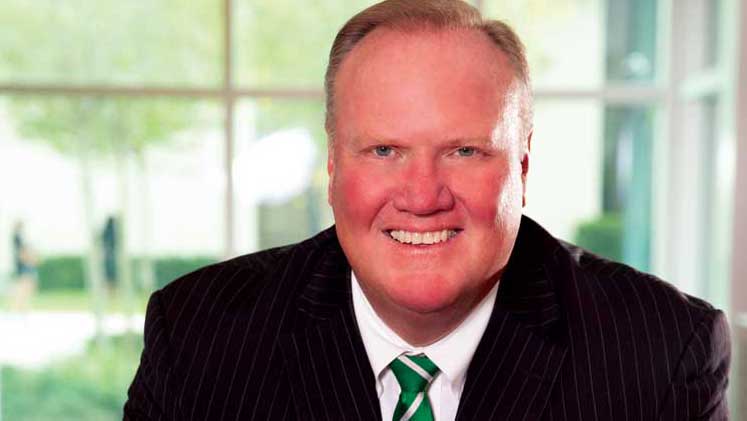
“We are all very excited about the growth of our Aerospace program and the vision for the expansion of it on the Titusville Campus with our Aerospace Center of Excellence,” said College President Dr. Jim Richey.
“As the aerospace industry evolves and expands across Florida’s Space Coast, we are reimagining how we train and educate the next generation of spaceflight technicians and specialists. Companies across the region are telling us the same thing—they urgently need more skilled aerospace technicians than we’re currently able to produce. That’s why we’re investing heavily in our Aerospace Technology program and facilities, so we can meet the rapidly growing demand. These careers offer high wages, exciting work environments, and long-term stability.”

CLICK HERE TO ENROLL TODAY!
Student Experiences: A Hands-On Approach
EFSC’s program draws students with diverse stories and goals, but one thing unites them – a shared passion for building, creating, and pushing limits.
Sydney Shell, a fourth-semester student, came to the program after seeing her sister succeed in aerospace. She had no aerospace background, just a love for hands-on projects, honed from years of helping her dad with car repairs and renovations.
Now, she’s preparing to graduate and has already secured an internship with Blue Origin. “One of the coolest things has been proving that I can do all the same things the guys can do,” she said. “This program has been a bonding experience with my dad. We’re going through it together.”
Shell wasn’t supposed to compete in Dallas, but she stepped in as part of the alternate team and helped win a first-place award. “Despite being unprepared, we won our event. I’m really glad I said yes and jumped in, even though I was nervous,” she said.

Jamnell Quinones echoed the excitement. “When I see a rocket, I just want to put my hands on it,” he said. “Working with cryogenics has been exciting. Our rockets use real systems that most schools don’t even touch.”
For Derek Ravelo, who grew up in Titusville watching launches and hearing stories from his father, who works for NASA’s security team, it’s all about applying knowledge. “You’re building rockets while learning to handle pyrotechnics and lay composite materials.
“We’re using both solid and cryogenic fuel, like real hybrid rocket systems,” he said. “Never in my life did I think I’d be working with carbon fiber.”
And for team leader Cody Akers, the program’s impact is as much about mindset as it is about mechanics.
“The level of precision required in aerospace work surprised me. One tiny mistake can affect billion-dollar projects. That’s a huge responsibility,” he said.

EFSC Shines at National Aerospace Competition
EFSC’s Aerospace Technology students recently made history at the Aerospace Maintenance Council Competition in Dallas, Texas, earning three first-place awards and putting their school on the map as a leader in hands-on technical training.
In the School Division, the “Titans” team took first in both the Antenna Gasket Installation Test and the Virtual Paint Booth, showcasing their technical expertise and teamwork under pressure.
Another EFSC team, the “Alternators”—a last-minute alternate group formed on-site from two EFSC students and one from Utah State College—won first place in the Simulated Spacecraft Vacuum Loading Event, a challenge judged by student volunteers from EFSC itself.
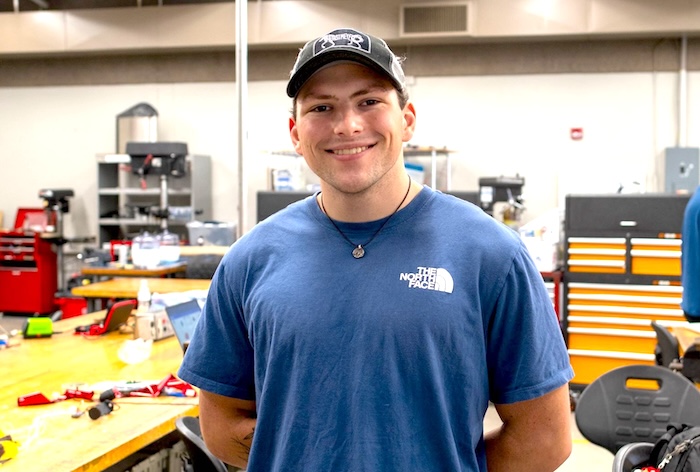
The student competitors included Jamnell Quinones, Cody Akers, Derek Ravelo, Sydney Shell, Marlon Cruces, Tyler Huskins, Holly Petty, and Josiah Robertson. They were coached by Ed Mango, Program Manager, and Chad Bryant, Aerospace Program Technician.
Beyond the trophies, the competition provided invaluable real-world exposure. “Our team actually took first place in three events,” said Derek Ravelo, a fourth-semester student.
“We really made our mark and represented our college well… it wasn’t just about the competition—it was about the connections, the learning, and realizing how big this world truly is.”
Industry Partners are at the Core: Why EFSC Matters
EFSC’s success isn’t just felt on campus. It’s recognized across the industry. Companies like Blue Origin, ASRC Federal, and Amentum (formerly Jacobs) regularly recruit EFSC graduates through internships and job placements.
“The Orion team represents some of the best human spaceflight aerospace workers in the world,” said Joe Velez of Orion AI&P Operations.
“Since 2015, we’ve partnered with EFSC to successfully cultivate and transfer skilled expertise from our current workforce to the EFSC students. Our local aerospace community is fortunate to have EFSC instill the foundation and mindset needed for our industry to thrive in the future.”
As companies ramp up operations in Florida, the demand for qualified aerospace technicians will only grow, and EFSC is positioning its students to meet that challenge head-on.
How to Get Started: CLICK HERE
No aerospace background? No problem. Many of EFSC’s top students began the program with zero experience in the field. What they had was curiosity, determination, and a willingness to learn.
The program currently runs four active cohorts through the Cocoa Campus and will expand in Fall 2025 to the Titusville campus, offering evening classes. Students can pursue a certificate to enter the workforce quickly or commit to the AS degree for broader career options.
Internships and apprenticeships are built into the program structure, allowing students to work directly with Space Coast employers while still in school. Entry-level technicians can earn $25–$30 per hour, potentially advancing to higher-paying roles in just 18–24 months.
The Launchpad to a Future in Aerospace
Whether you dream of working on spacecraft systems, launching rockets, or advancing into aerospace engineering, EFSC’s Aerospace Technology program offers a path to make that dream real. With award-winning students, industry-aligned training, and unmatched access to Florida’s space sector, EFSC is not just preparing students for jobs. It is launching them into lifelong careers.
CLICK HERE TO ENROLL TODAY!