Health First’s Innovative Hospital at Home Program Underscores Commitment to Meeting Patients Where They Are
By Space Coast Daily // April 30, 2025
Home Program Continues Growth and Popularity

Brevard County’s not-for-profit health system is a national innovator in transforming hospital care – outside hospital walls.
BREVARD COUNTY, FLORIDA – Originally created out of a combination of necessity and opportunity during the COVID-19 pandemic, Health First’s innovative Hospital at Home program has surpassed its fourth year of operations – serving more than 1,200 patients in Brevard County, and those numbers are only expected to continue to climb in the coming years.
And as Brevard County has this month experienced the loss of the second largest hospital and emergency department with Orlando Health’s closure of Rockledge Hospital, Health First’s innovative Hospital at Home program underscores Health First’s commitment to meeting patients “where they are,” while serving the community’s health needs.
Begun in 2021 as a way to open hospital space for COVID-19 patients, the “hospital outside of the hospital” model was operationalized by Health First before nearly any other healthcare system in the state of Florida.
It serves patients who are sick enough to be admitted to a traditional brick-and-mortar hospital but stable enough to have hospital-level services administered in the comfort and familiarity of their own home.

Leveraging wearable monitoring technology to track patient vital signs, advanced telemedicine, and in-person care, Hospital at Home enables care teams to monitor, communicate, and intervene with care plans consistent with the standards of care provided in a traditional hospital unit.
“This is a tremendously successful model of providing acute-care, hospital-level medicine outside of the physical walls of a hospital to those who provide compassionate round-the-clock care and monitoring,” said Dr. William Johnson, Hospital at Home Medical Director.
“The program was initially developed when hospitals were experiencing heavy volume from COVID. But today, as we are experiencing a different sort of challenge here in Brevard with the closure of Rockledge, many people are asking, ‘Where can I go for care?’ or What options are now available for me?’
“This program is certainly not for everyone, of course. We are still growing the program to expand to more and more patients across all four of our hospitals. But it certainly demonstrates Health First’s commitment to finding solutions … and providing options for our patients and their loved ones,” Johnson continued.
Supported by a robust clinical infrastructure, the program allows patients presenting at any of Health First’s four hospitals to be evaluated for one of numerous conditions eligible for Hospital at Home, including, but not limited to:
■ Urinary tract infection
■ Simple pneumonia
■ Cellulitis
■ Congestive heart failure
■ Dehydration
■ Chronic obstructive pulmonary disease (COPD)
■ Bronchitis and asthma
■ Skin infections
■ COVID-19
Patients for the program may receive:
■ Transportation to their home if needed
■ Support from a dedicated coordinator who guides their care
■ Delivery and set-up of all necessary equipment, medications, and supplies
■ 24-hour remote monitoring of their vital signs by our clinical team
■ Two in-home visits by a clinical team member
■ Daily in-home or virtual visits from a nurse practitioner, physician assistant or physician
■ Support to coordinate all needed services and follow-up appoints after discharge
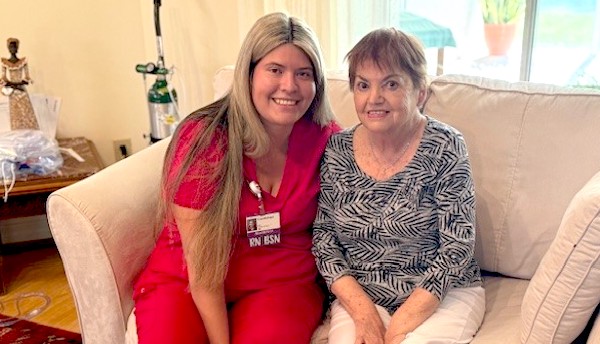
Recent studies show that patients receiving care in their home environment experience fewer hospital readmissions and visits to the Emergency Department, less time in bed and increased patient satisfaction. Further, other hospital systems with similar initiatives have shown favorable outcomes for patients treated under the same model.
Johnson explained the program enables hospitals to extend their bed capacity, improve patient outcomes and create higher patient and staff satisfaction, all while making hospital costs more efficient.
“Health First has demonstrated that acute care conditions such as asthma, congestive heart failure, pneumonia, respiratory infections, sepsis and chronic obstructive pulmonary disease can in many cases be safely treated in home settings with proper monitoring and treatment protocols, and in a majority of cases these result in fewer readmissions, lower infection rates and higher patient satisfaction,” said Johnson.
Begoña Denny and her husband Greg have lived in Melbourne for decades. When she began suffering from fatigue, accompanied by a consistent cough, she and Greg knew it was time to seek care at the nearest hospital – so they went to Holmes Regional Medical Center.
“We ended up spending a couple of nights at Holmes Regional as they worked to figure out what the problem was. And after two days, they came to us and asked if we would be interested in the Hospital at Home program,” Begoña recalled.
“I have never heard of a program like that before, but I hope they continue to offer it at hospitals. It has been wonderful, and I feel like I have gotten much better from my pneumonia much quicker than I might have in the hospital. I’m able to be in my own home, eat my own food, sleep in my own bed. They monitor me very closely, and the doctors and nurses are wonderful. My nurse comes in a couple of times each day to check in on me and helps me to do my breathing exercises. It’s a much nice way to get better – it makes me feel special.”
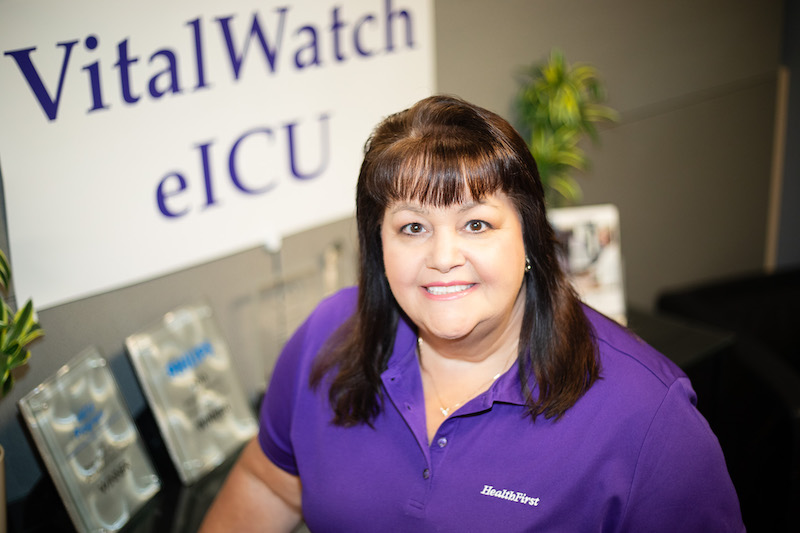
Additional Layer of Protection: Health First’s “Eye in the Sky”
While Health First’s Hospital at Home patients receive compassionate, timely, cutting-edge medical care in the home setting, there is an added layer of security closely monitoring their progress.
That “eye in the sky” – Health First’s innovative VitalWatch Electronic Intensive Care Unit (eICU) – recently celebrated its 20th anniversary as Brevard County’s only consistently-operating eICU program.
Health First’s eICU was created and launched in 2004 to enhance care provided to patients within an Intensive Care Unit. Over its 20 years of service, the eICU team – comprised of Intensivist physicians, nurses, unit coordinators, and pharmacists – have provided expert clinical care to more than 150,000 Health First patients.
“The VitalWatch eICU team uses specialized state-of-the-art audiovisual communication and enhanced computer systems to be an active partner in caring for patients. With this technology, the staff and patients can see and talk to the eICU team from their hospital rooms,” explained System Director for VitalWatch eICU and Intensivist Programs Luann Tirelli.
“Close to 4,500 lives have been saved by the expertise of the eICU team working with the doctors, nurses, and other staff caring for the patients in our four Health First hospitals. These moms, dads, brothers, sisters, aunts, uncles, siblings, etc., were able to return home to their families because of the care they received during their Health First hospital stay.”
The VitalWatch eICU team monitors approximately 10,000 patients annually across Health First’s four hospitals and 102 ICU beds.

In just this past year, the program has yielded incredible, eye-popping results, including:
■ 500,000 eICU telemedicine video assessments
■ 65,000 telephone calls with the ICU’s for care collaboration
■ 90,000 eICU Intensivist physician orders
■ 25,000 eICU RN nursing interventions
■ 5,600 eICU Pharmacist medication interventions
The impact of the VitalWatch eICU also extends beyond the ICU, leading to significant reductions in the time a patient spends in the hospital, Tirelli said.
“Patients cared for by VitalWatch eICU and the bedside care teams were able to leave the ICU faster than expected, saving over 60,000 ICU days and 100,000 hospital days. Our team is there at times of crisis, at times of routine care, and at times to be an extra comforting voice, day or night, for the ICU patients and their families.”
 Related Story:
HOT OFF THE PRESS! April 14, 2025 Space Coast Daily News – Brevard County’s Best Newspaper